
Birds of Southern Africa #4
- Sep 21, 2024
- 4 min read
Updated: Oct 8, 2024
My final post on South African birds seen on our recent trip has to include the wonderful bee-eaters, small insect eating birds with fantastic aerial skills. You'd have to be good to catch insects while on the wing. We spotted three different species of bee-eater in our travels: the Little Bee-eater, the White-fronted Bee-eater and the Southern Carmine Bee-eater - the latter being my personal favourite, even though our sightings of this were fleeting and in the wrong light. Still, it's a beautiful bird.


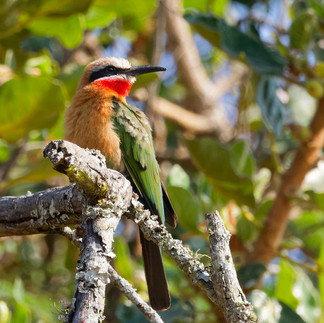




When not flying, White Fronted Bee-eaters live in holes in the river bank (Pic by Natalie).

And if you see nothing else, the kingfishers leave a memorable impression with their incredible blue plumage, over-sized beaks and amazing aerial abilities. This is the Brown-hooded Kingfisher - quite common in Southern Africa. (Pic by Natalie).

This is the Giant Kingfisher so named because it's very large, though not quite as large as its cousin the Australian Kookaburra (or 'Guguburra' in the local Wiradjuri language).


The glorious Malachite Kingfisher seen along the Chobe River, Botswana.


We saw several Pied Kingfishers along the Chobe River. Natalie managed to get great shots of the bird hovering - something I never knew they could do. The bird would hover for 10 or 20 seconds before dropping height closer to its intended prey, hovering again and then dropping into the water to catch whatever it was it was after. A lot of energy expended for the possibility of something to eat.

The beauty of travelling along the Chobe River in a small boat is that you can get really close to a lot of the wildlife. I was a bit nervous about running over a sleeping hippo but the ranger was very careful - he'd kill the motor and we'd drift into the reed beds to look for animals and birds. Here's another shot by Natalie of the beautiful Pied Kingfisher. In these instances a big telephoto lens is more of a hinderance than a benefit because you get so close to the wildlife!

Crested Barbet at sunset (Pic by Natalie).

Another Crested Barbet (Pic by Natalie)



You see a lot of large waterbirds in Africa, more so obviously when near water. Here are four different species: the Grey Heron, Saddle-billed Stork, the Wooly-necked Stork, a Goliath Heron (with a Jacana) and a Greater Egret.

Three-banded Plover doing what these small plovers like to do - search the river edges for food.

You get to see a lot of Hornbills in Southern Africa. This is the common Yellow-billed Hornbill. (Pic by Natalie)

Less common is the Southern Ground-Hornbill, the largest of all the hornbills. They can live up to 60 years, weigh up to 6 kilograms, and are actually carnivorous, feeding off insects and small vertebrates.

Although almost completely grey, I think the Grey Hornbill is still a very glamorous bird.

Another great shot of the Yellow-billed Hornbill (Pic by Natalie).

Red-billed Hornbill (picture by Natalie).

One of the most iconic of all African birds, the Lilac-breasted Roller is a veritable explosion of colour.


An assortment of Lilac-breasted Roller shots. (Most of these pics by Natalie)

The stunning Golden Oriole, quite a common bird in Southern Africa.

Vultures are to be found all over Southern Africa - wherever there's been a kill you'll probably see vultures. This is the Hooded Vulture - quite a small bird as vultures go - this one was sitting in a tree only about 20 feet above a lion that was chewing on a warthog, waiting for some of the left-overs.

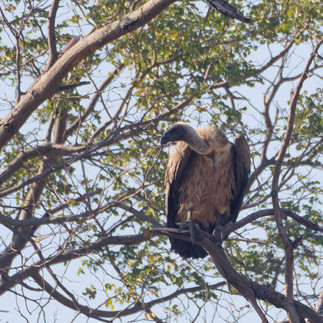


Three White Backed Vultures in very different locations. This is the commonest of all the vultures in Southern Africa, weighing up to 7 kilograms with a massive seven foot wingspan - although this is by no means the largest vulture. The Lappet-faced Vulture, which I didn't get a good picture of, has a wingspan of nearly ten feet. (Pics by Natalie).

Some of the birds of prey are quite hard to identify - they flay fast and high so their true colour is hard to see. Our game ranger for that trip identified this bird as a Yellow-billed Kite. I was not going to argue with him!

Thank goodness for software. This shot was taken very early in the morning (6am) directly into the light, so essentially I just got a very grainy, uninteresting silhouette. But with a little tweaking in DXO PhotoLab I managed to squeeze a reasonably good looking image out of the RAW file, despite the high 8000 ISO setting.

Once the file was brightened up I could see that the bird has a distinctive red beak and red legs - making identification a lot easier. Not the best image - this is the Dark Chanting Goshawk.

This is the Red-crested Korhaan (also known as the Red-creasted Bustard) is a very distinguished looking bird that haunts the grasslands of Southern Africa. At a distance it looks quite innocuous but when you get close you can really appreciate its beautiful plumage. In the breeding season the Korhaan displays a fantastic wine-red crest (not seen on this trip).


Another very common bird is the Cape Turtle Dove - you see them everywhere!

Last, but by no means least, is the Helmeted Guinea Fowl. You see these large, chook-sized birds all over Southern Africa, usually like this, in groups of five, ten or more birds. They can fly perfectly well but they'll only take off when a predator gets too close for comfort. From a distance they look like animated tea cosies.


Comments